Introduction to SFX, VFX & CGI

A space odyssey (1969)
Director Stanley Kubrick
This movie follows a story of human evolution and intergalactic space travel. Throughout the movie our vision is ensnared by wonderful images of hyper realistic 3D models, with excellent VFX that some say paved the way for the future.

Pirates of the Caribbean -The curse of the Black Pearl (2003)
Director: Gore Verbinski
This movie predominately follows the story of jack sparrow, this specific instalment from the five part franchise has our lead protagonist sailing the seas and meeting with undead which leads to the audience observing stella CGI which is considered far ahead of its time in the VFX scene. There is 3D animation and plenty of water simulation.

Terminator 2 – Judgement day (1991)
Director: James Cameron
The sequel to terminator 1 follows John Connor as well as artificial intelligence known as terminators from the future leading into a action driven story where our protag is saved by one of the two terminators who have been sent after him with different intentions. This movie is very well know for its intense simulations and character models. As well as for its film methods that allowed it to create never seen before effects.

Tron Legacy (2010)
Director: Joseph Kosinski
Delving into the large and obscure world of sci fi we come face to face with our main protagonist Sam Flynn who emerges into the digital world trying to uncover the mysterious that lead to the sudden disappearance of his father. Story aside this movie is well known for its approach with digital human creation and the way they incorporated live action and CGI.

Lord of the rings (2001)
Director: Peter Jackson
This is a trilogy of epic fantasy adventure films. Predominately following a Hobbit from the Shire, who sets out on a journey along side his eight trusted companions to destroy the ring and save Middle-earth from the Dark Lord Sauron. Even among bigger fish this trilogy is acclaimed for its stunning visuals, effects, and multi layered world-building.
Week 1: Module introduction and exploring differences between special effects, visual effects, and CGI.

Eadweard Muybridge was a 19th century photographer who created images to understand, study and convey movement. The image above is but one examples of his work. Using a series of photos the photographer was able to study the motion of birds while flying. This work was later passed on and became one of the building blocks of motion in movies.
IMPORTANT QUESTIONS
-
What are Special Effects, Visual Effects and CGI? What do you understand these terms to mean?
From my understand special effects are physical effects used to create a scene. Items like fake blood, on set explosions, smoke are all real tangible things in real life that can be used by us to create the shots we want to present.
VFX on the other hand is computer generated or digital, these are items that are added later such as compositing or lighting, green screen. these things do not exist in real life in the traditional sense or would be nigh impossible to film and such is added later through digital means.
CGI is a part of VFX it is using Digital tools to generate images, scenery, environments, 3d models or animations.
-
How do we define SFX and VFX?
SFX happens in camera meaning the stuff is already there physically. VFX happens later.
-
How are these things different and similar? Where are the crossovers and evolutions?
They are similar in the sense they both are trying to portray something as real or set out to enhance what is real. Places where they can crossed over and evolved would be scenic effects and simulations.
Scenes that involve explosions, smoke fire or water can be rendered entirely on computers using software however many still use real life footage as some argue it can be more realistic than the alternative.
-
Key terms/terminology associated with VFX, SFX and CGI
- COMPOSITING
- MATTE PAINTING
- GREEN SCREEN
- 3D MODELLING
- POST PRODUCTION
- TRACKING
- SIMULATIONS
-
Favourite VFX shot:
This is a scene from Multiverse of madness, the details, effects and shots are magnificent.
Homework Task – Week 1
This article is written by Kyle Deguzman and breaks down key differences between the three main film effect area. It goes into detail about what each one means, how they work and how they can often overlap in current gen film making.
VFX here is defined as the implementation of digital effects and elements into real live footage. It is often used when it would be far too dangerous, expensive or impractical to actually film if not impossible. Examples of this tend to be underwater , creating creatures, digital lighting.
CGI is a very specific part of VFX which focuses on creating imagery completely from a computer, using software such as: Blender, Maya and Z-brush. Creations from these software’s are often characters, environments or 3d models
SFX on the other hand is the process of using in real life means to create effects or imagery. Items like prosthetics, smoke, rain machines are examples of using props or tools to garner specific effects or scenes without the use of a computer.
Kyle Deguzman goes into depth about the lines between the categories are beginning to blur as i noted in my own findings. Scenes that involve explosions, smoke fire or water can be rendered entirely on computers using software however many still use real life footage as some argue it can be more realistic than the alternative. However industry professionals understand each of the their limitations are are opting for “synergistic” approaches that leverages the best of all the worlds. He details that films like Jurassic park, avatar and lord of the rings already mix practical and digital effects perfectly.
Overall, this article is great because it clearly defines and breaks down each category and helps us understand how filmmakers balance creativity and realism on the big screen. Another reason it is so great is because it actually sits source such as case studies so we have genuine evidence and not just word of mouth. Indicating that he is a good source.
Case studies he listed are:
Star wars: a new hope.
Avatar 1 & 2
Oppenheimer
To conclude my understanding has been shown to be accurate through detailed explanations and revision on the subject topic. The source provides details and examples of works that follow the narrative that i both understand and laid out above. Most importantly my understanding has been backed up by case studies that are laid out in Kyle Deguzmans article.
Week 3
What are the differences between invisible and spectacular vfx.
Invisible and Spectacular VFX can be be differentiated by not only the effect it has on the audience but its intended use cases and how movie markers and vfx artists employ the use of each technique.


invisible VFX can be described as an assisted slope for both visual narrative and on camera effects.
Examples of this would be using a green screen set and with props and rigs and then using 3D modelling to bring in assets which could be a building, a boat even additional models of props. The purpose is to look realistic, subtle, seamless and naturalistic. The goal is not to show off spectacular VFX but assist what is on camera. Things like explosions or water effects could fall into this category, to enhance or properly capture a scene in its intended way which could be cheaper and easier to do outside of real world limitation.


Spectacular effects can be used as a means of storytelling as well as just being eye catching, fantastical or cinematic. movies such as doctor strange in the above images brings life to the narrative. spectacular VFX is great because even though the audience suspends belief their is realism embedded into the function of it and is grounded into the laws of the world of the story.
It is eye catching and overt, isn’t hidden and is direct for the audience to see, because of this it allows directors and VFX artists to incorporate obviously unreal scenes that still suck in the audience.
Homework Task 2
The article goes into depth about visual effects and how subtle they can be compared to what is often thought first when discussing vfx.
visual effects such magic, explosions and other CGI are often seen as the corner stone or pinnacle but there is more to it than that.
Vfx can be invisible, what this means is that it blends into the scene, complements it and is often times not supposed to be overt or spectacular.
In essence you are not supposed to know its there is should be seen as real by the audience, this what makes it “invisible.”
The article looks at how this skill is used in tv shows and movies, depending on the set and production this could be working on individual frames, cleaning shots, extending environments,
recreating historical artifacts and the list goes on. Tv shows like “The Crown” is infamous for this.
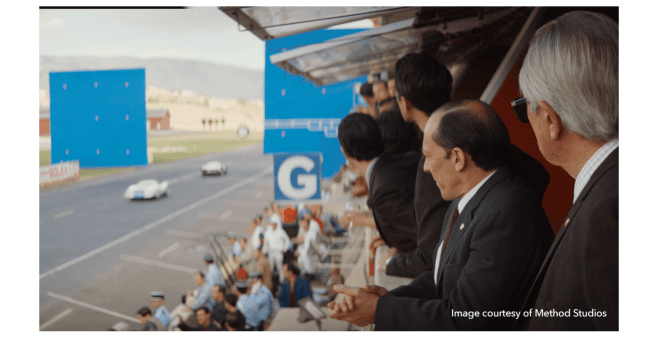
The article talks about mank as it blends old style Hollywood making with modern vfx using rear projection and led tech.
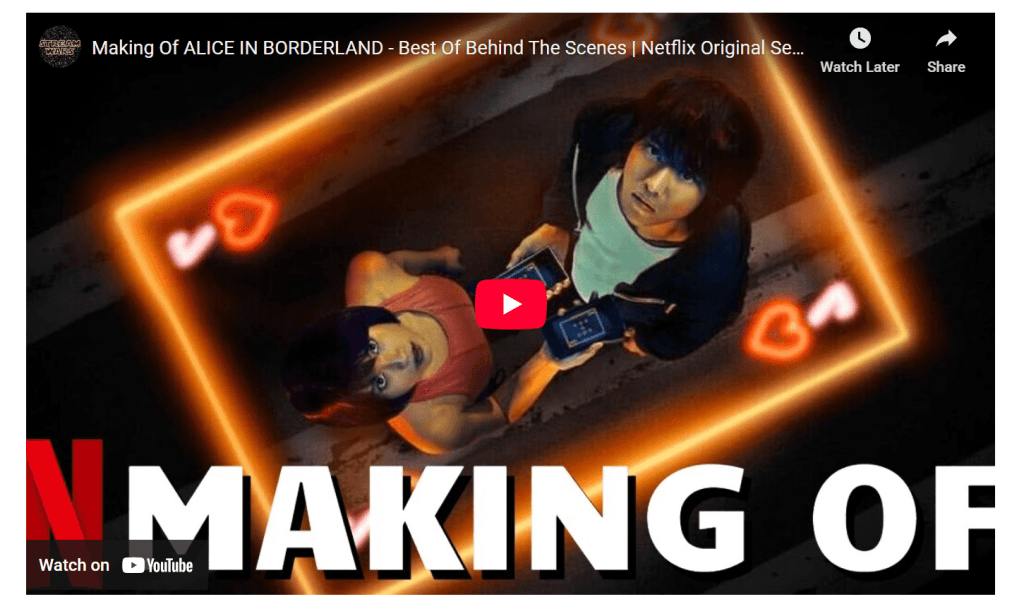
more examples given is allice in borderland and the haunting of Bly manor: Creating empty cities, mansions that are completely CGI and changing or altering the lighting.
The article is concluded by saying neither invisible or visible vfx are better and just the fact that the vfx are invisible doesn’t automatically make it good either.
to quote says “perhaps this is because the story, narrative and craft that typically underpin acclaimed films so enchants us that we’re more likely to forgive and forget VFX that’s sub-par, or ‘visible’.”
basically stating the idea that vfx is but a cog in what it takes to make a good movie great CG or not.
what matters is how the serve the story and what can be derived from them.
Overall i thought the article was interesting and made me look into movies as a whole not just my sector.
Week 4 Historical VFX
Class Task 1: Discovering the Lumière Brothers
NOTES:
Auguste Lumière was born on October 19, 1862,
Louis Lumière on October 5, 1864, in Besancon, France.
They were the sons of a painter turned photographer.
Key film was Arrival of a Train at La Ciotat (1895), which famously showed a train pulling into a station.
SHORT BREAKDOWN:
The lumiere brothers changed film forever with their invention of the cinematographe, which worked as a camera, printer and projector all in one.
Their first screening in 1895 at the grand cafe in paris is revered as the birst of cinema.
A urban legend of them is that their showing was so profound the film arrival of a train at La Ciotat had watchers jump and run because it looked like the train was heading straight towards them.
Another think to note is unlike Georges melies they wanted to film real life and did short clips known as actualities.
These were every day scenes and began the process of documentary filmmaking.
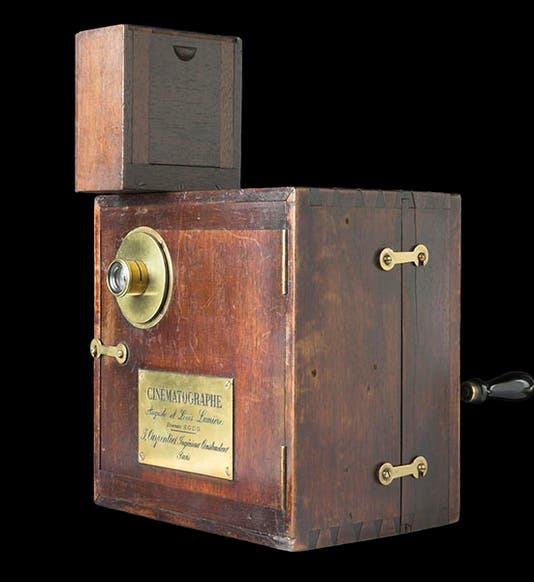
WHAT IS MOVING IMAGE:
-Sequence, the order of which an event and or images has taken place. Natural progression.
-frames. Fps how much is tracked in still images (one frame or many) in a second
EADWEARD MUYBRIDGE:
an English photographer known for his pioneering work in photographic studies of motion, and early work in motion-picture projection.
In 1877 he returned to California and resumed his experiments in motion photography,
using a battery of from 12 to 24 cameras and a special shutter he developed that gave an exposure of 2/1000 of a second. This arrangement gave satisfactory results and proved Stanford’s contention.

Georges Méliès:
born in 1861 Georges was a French filmmaker and illusionist. He is known for being one of the pioneers of cinematic special effects.
after watching the Lumiere brothers he became interested in fantasy and storytelling. turning cinema into a form of visual magic.
He used stop motion to make objects disappear and reappear, layered images and painted frames to give the effect of colour even before the invention of colour film.
Some of his key films are: A trip to the moon(1902), the vanishing lady(1896) and the impossible voyage(1904)
through these three movies he established and demonstrated his use of complex sets and uses of costumes, showcased stop camera techniques and creative editing.

The rocket lands on the moon (A Trip to the moon)
Makes use of painted backdrops, layers and props.
the lady vanishing from a chair (the vanishing lady)
makes use of stop camera
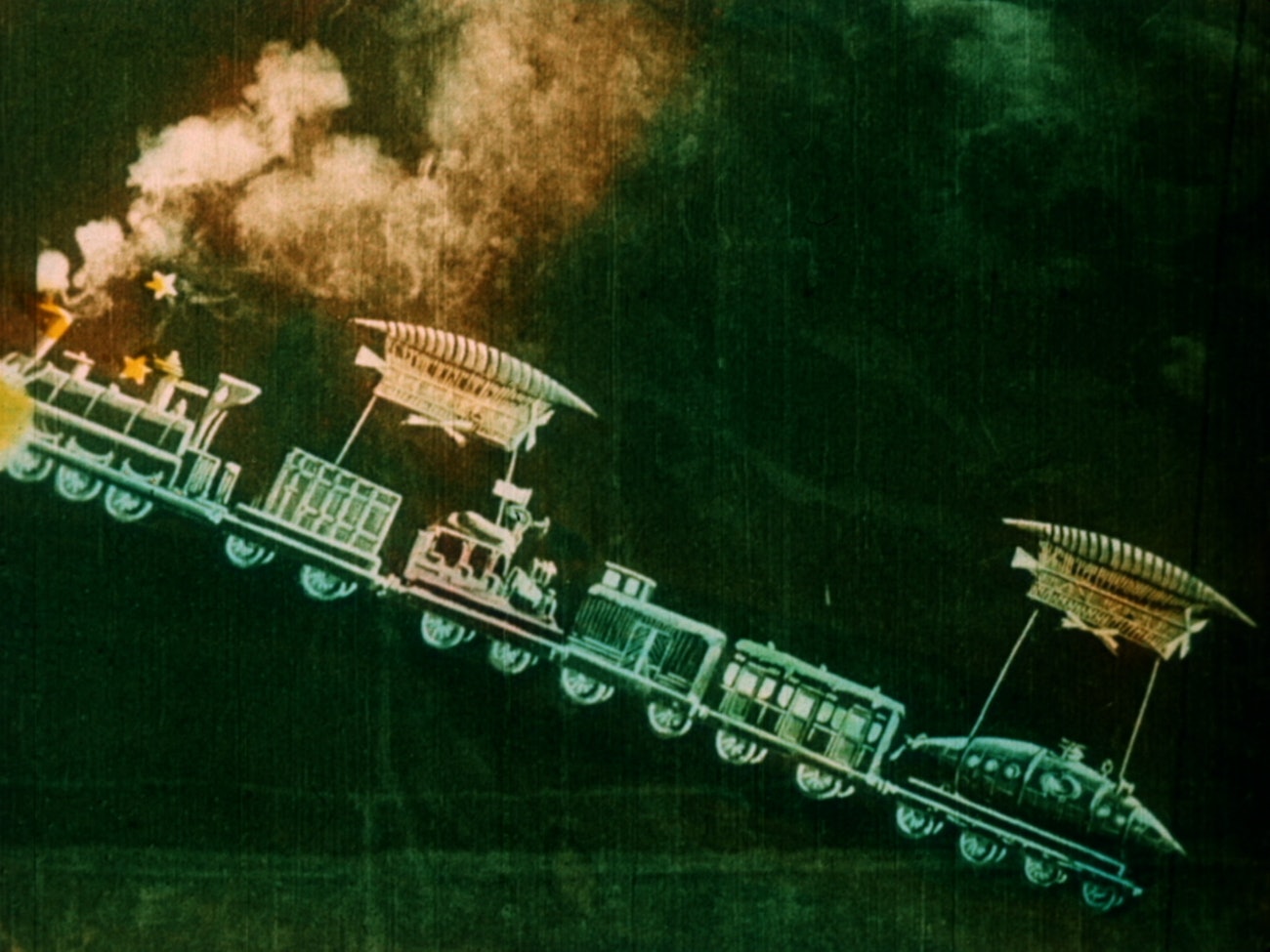
(The impossible voyage)
Uses models and rapid scene changes to give of the effect of travelling.

Homework assignment:
Week 5:
Class Tasks: Write about Harryhausen, and consider why his work was essential to the history of visual effects. What were his key animation techniques? How was he influential to later movie directors?

-
Please write a short paragraph on who Harryhausen was and why his work was essential to the history of visual effects.
Ray Harryhausen changed how people saw special effects. before CGI he brought monsters to life by using stop motion animation.
Well known as a pioneer of “Dynamation” and advance the field of cinematic special effects
He worked on films like Jason and the argonauts and clash of the titans.
He made everything feel real and gave event still objects personality, Showing how fantasy could blend with live action in a believable way.
what made him essential to film history was that he pushed the limits of what could be done practically.
everything was handmade, frame by frame, but it still managed to give off real long lasting effects on the audience.
steven Spielberg, Tim burton and peter Jackson all give credence to Harryhausen inspired their works and world.

2. Please write a short paragraph on a special effects technique that Harryhausen used, any method from his films. See what you can find out.
Harryhausen main technique was was called Dynamation. this was a process that combined live-action footage with stop motion animation in the same frame.
First actors would be filmed then he would animate models frame by frame so they appear to move an interact with real people. this method however took incredible amounts of time.
Taking days and even weeks to get even a couple seconds of movement. This became the foundation for modern visual effects. Showing adults that animation could be more than just cartoons.
Ray Harryhausen Annotation:
Alison Eldridge’s piece on Ray Harryhausen offers a concise overview of how Harryhausen revolutionised visual effects through his mastery of stop-motion animation.
The article charts his early fascination with films like King Kong (1933) and describes how he used this inspiration to develop his signature technique of “Dynamation”.
Which he called this due to believing adults would see it as childish
he layered animated models with live action footage to make creatures interact convincingly with human actors.
It emphasises his projects like Jason and the Argonauts (1963) and Clash of the Titans (1981) noting how his techniques influenced generations of filmmakers, including Steven Spielberg and George Lucas.
The article also touches on his legacy, referencing the awards and institutional recognition he received later in life.
Harryhausen is noted to stand alongside cinematic pioneers and Eldridge argues that his practical, handcrafted approach laid the groundwork for modern visual effects.

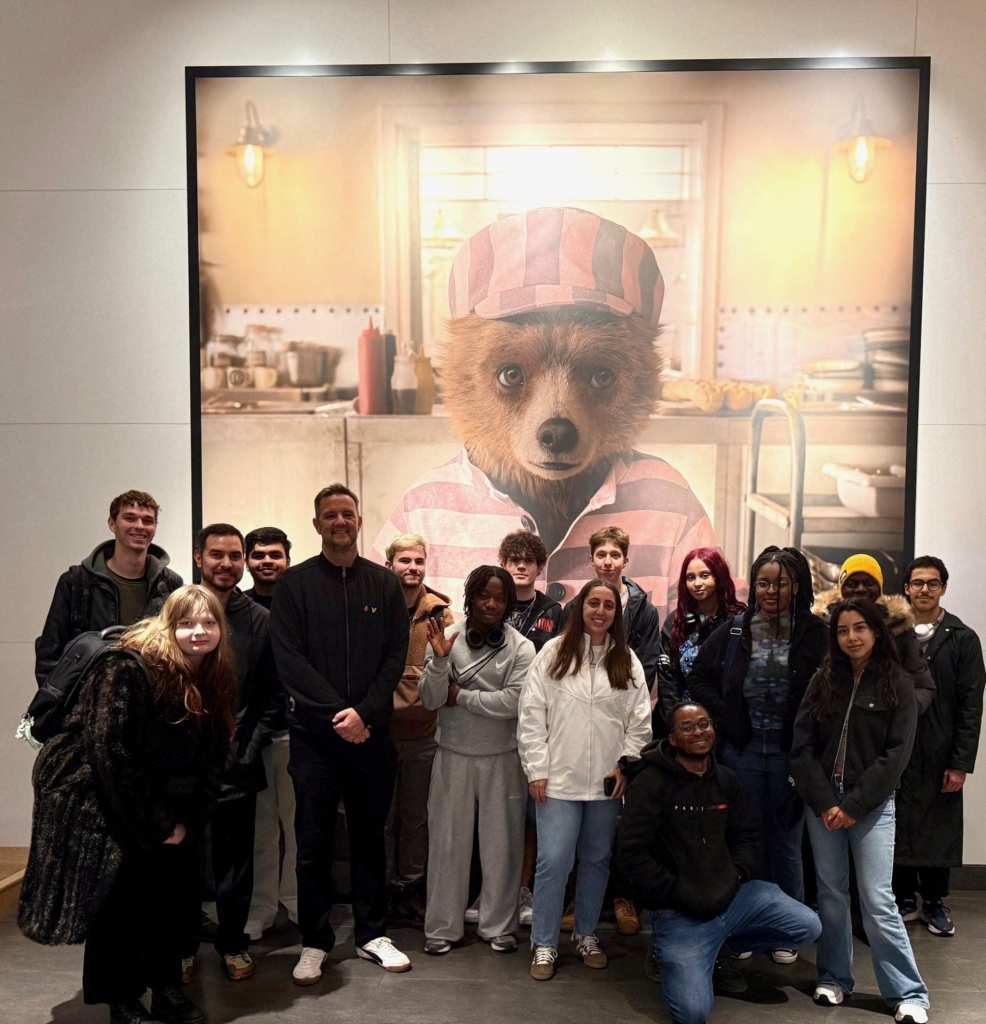
FRAMESTORE TRIP:
Things i wanted to ask:
Creative + Design Questions?
• How closely do you work with the directors or showrunners when designing creature expressions or movement?
we work hand in hand with directors and those who produce do camera work meaning were able to tips and point out things that’ll make creating animals and creatures work better for us.
• Did you have to study animals?
theyre always learning and have comphensive studies on going in frame store that teaches all staff and updates them along their journeys.
Technical / Production Questions
• How long does it usually take to complete one high-quality VFX shot?
sometimes even a minute of film can take months at a time and multiple people to help and create.
Career + Industry Insight
• What kind of roles or skills are most in demand at Framestore right now?
all roles are always in demand at differenet points so its better to focus on being profiecent in the areayou like most and or just be a generalist.
• How do you balance technical skill with artistic vision.
WEEK 6
The Advent of the Computer Generated Image

Terminator 1984 used stop motion and animatronics
Terminator Genisys uses CGI

The thing 1982 used practical effects
The thing prequel 2011 used CGI

lord of the rings 2001-1003 used miniatures and practical sets
The hobbit trilogy 2012-2014 used CGI environments

Alien 1979 had a man in a creature suit.
Alien covenant 2017 used a CGI xenomorph
Jaws 1975 use animatronic sharks
The meg 2018 used CGI sharks
FIRST CGI IMAGES AND MOVIES:
Key figures in CGI history
Alvy ray smith:
an computer scientist and animator.
He is the co founder of Pixar, who pioneered computer paint programs.
co developed the alpha channel in digital compositing that allows transparency in digital images.
Co developed Pixar’s image computer technology.
Smiths work laid the groundwork for digital image editing and modern cgi compositing. Without his alpha channel many things such as layering and blending would likely be very different if exist at all.
“animation is not the art of drawings that move but the art of movements that are drawn”
Loren Carpenter:
an computer graphics researcher and pioneer in procedural and fractal-based animation.
He worked at Boeing before joining Lucasfilm and later Pixar.
Created the short film Vol Libre (1980), one of the first examples of 3D fractal animation.
Helped develop the RenderMan software used for creating realistic lighting and textures in Pixar films.
Co-founded Pixar and worked on the Reyes rendering algorithm.
Carpenter Introduced fractal landscapes — realistic terrain generation using mathematical fractals.
His research revolutionised the realism of computer-generated environments and lighting.
John Lasseter
An animator, director, and producer.
He directed Pixar’s first feature film, Toy Story which is the first fully computer-animated movie in history.
Directed a bug’s fife, toy Story 2 and Frozen
He pioneered using CGI for character animation, pushing software to handle expressions and emotions.
Lasseter transformed CGI from a technical novelty into a storytelling art form.
Edwin Catmull:
computer scientist and co-founder of Pixar.
he was its president for decades.
he invented texture mapping, bicubic patches, and subdivision surfaces.
co-created the short A computer animated hand which is one of the first 3D animations ever.
helped form the Pixar Imaging Computer Group and later led Pixar Animation Studios.
he developed the Z-buffer algorithm
He helped develop RenderMan with Loren Carpenter.
Catmull’s mathematical and engineering is the backbone of all modern 3D animation software.
“failure isnt a necessary evil. in fact it isnt evil at all. its a necessary consequence of doing something new”
HOME WORK ASSIGNMENT 6
Manovich explores the historical and conceptual transformation of cinema based on digital technology.
the section in from anitation to cinema shows how he interprets cinema. he says that it started to shift and distance its self from animation and hand crafted and artifical origins.
aniamtion is said to have embraced being fake and/or artifical while cinema tried to disguised and hide this fact. promoting illusions and a captured reality.
TThe technqiue used before hand such as paintimngs , minatures and optical tricks like having acts act out scenes while the rest of the film is done stop animation were less used and marginalized to preserve realism.
In the “What is digital cinema” segment manovich tells and argues that digital filmamaking trys to get rid of the divide between cinema and anikmation.
The creation of CGI and digital compositing cinema uses manuel image creation.
digital cinema starts to blur the lines between multiple types of arts such as photography, painting and film. live footage is able to be edited or changed down to even small pixels.
in the end the conclusion is that digital cinema is not an evolution of cinema as a whole but a new method of image construction that can be incoperated into cinema.
This article more or less is important because it challenges what we think we know or understand to be cinema. how we define animation and the traditional definitions of realism.
Week 7: Topic: What is “The Uncanny Valley” in computer animation?

Mia winter biohazard resident evil.
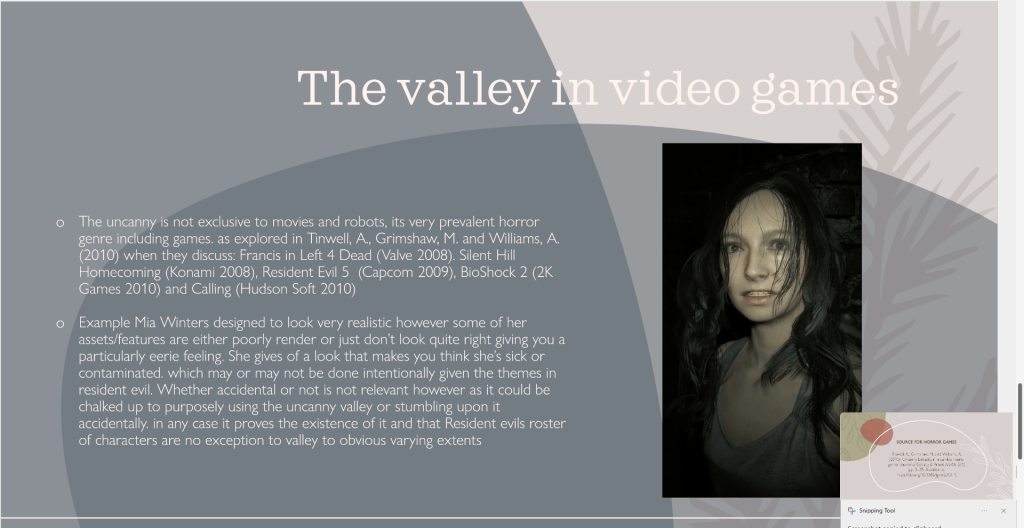
Her eyes, eyebrows and facial expressions are hyper realistic but her hair and mouth do not appear to be made to the same quality giving a unsettling feeling.
the realism with the eyes and face draws us in but the stiffness of hair and mouth creates tension despite us being aware that it is indeed a game.

MY UNCANNY VALLEY GRAPH
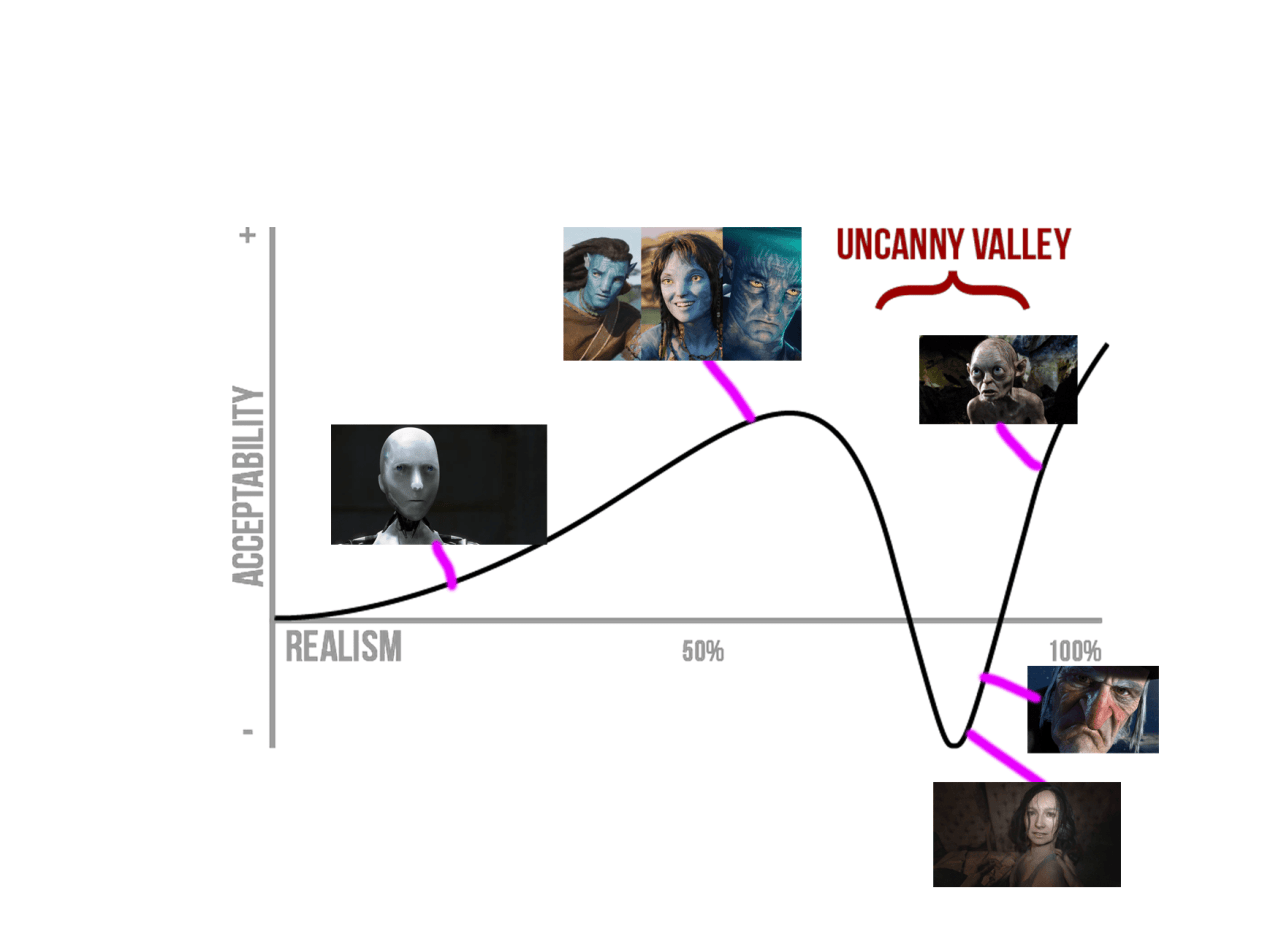
Explanation of the uncanny valley:
The uncanny valley is characterised by the feeling of uneasiness and uncomfortable feeling made by creatures, objects or robots that appear or are designed to look human but in a way fail to do so.
this theory was created by a roboticist named Masashiro Mori in an essay back in 1970.
he proposes that as human likeness increases in an object’s design, so does one’s affinity for the object but only to a certain point.
once it becomes to perfect it begins become bad or give a feeling of repulsion or eeriness.
This phenomena is very important to movies and vfx artists because it may underpin the way in which viewers respond to movies and or how well the movie is received.
This could be the movie being less believable, characters not looking realistic or even the audience not liking the emotional depth shown within characters.
ASSIGNMENT 6 THE UNCANNY:
lay, s. (2015 ) Uncanny valley: why we find human-like robots and dolls so creepy. Available at: https://www.theguardian.com/commentisfree/2015/nov/13/robots-human-uncanny-valley (Accessed: 20 november 2025).
The article written by Stephanie Lay introduces the readers to the concept in a clear cut and precise way allowing the audience the understand and engage with what is being laid out. Stephanie cleverly points out that the emotional responses to the near human robots are not always eerie or negative and beyond the uncanny lies another valley that beings back positivity making the citing the claim that If human-likeness goes up past the valley, the reactions return to being positive.
Lay acknowledges the elusiveness of this theory due the subjectivity of the topic. despite this however she mentions a protentional shift as researchers have supposedly found a clear valley effect within a study of 80 robots. Lay then goes on to provide her own research. after reading through I am particular intrigued by her second and third pieces of research.
Overall I am of the opinion that this article is well written and a great deep dive into the topic of the uncanny. it provides a plethora of studies to provide evidence and highlights the key fundamentals and ideas of what the uncanny valley means.
Week 9 – The Disney and the Principles of Animation
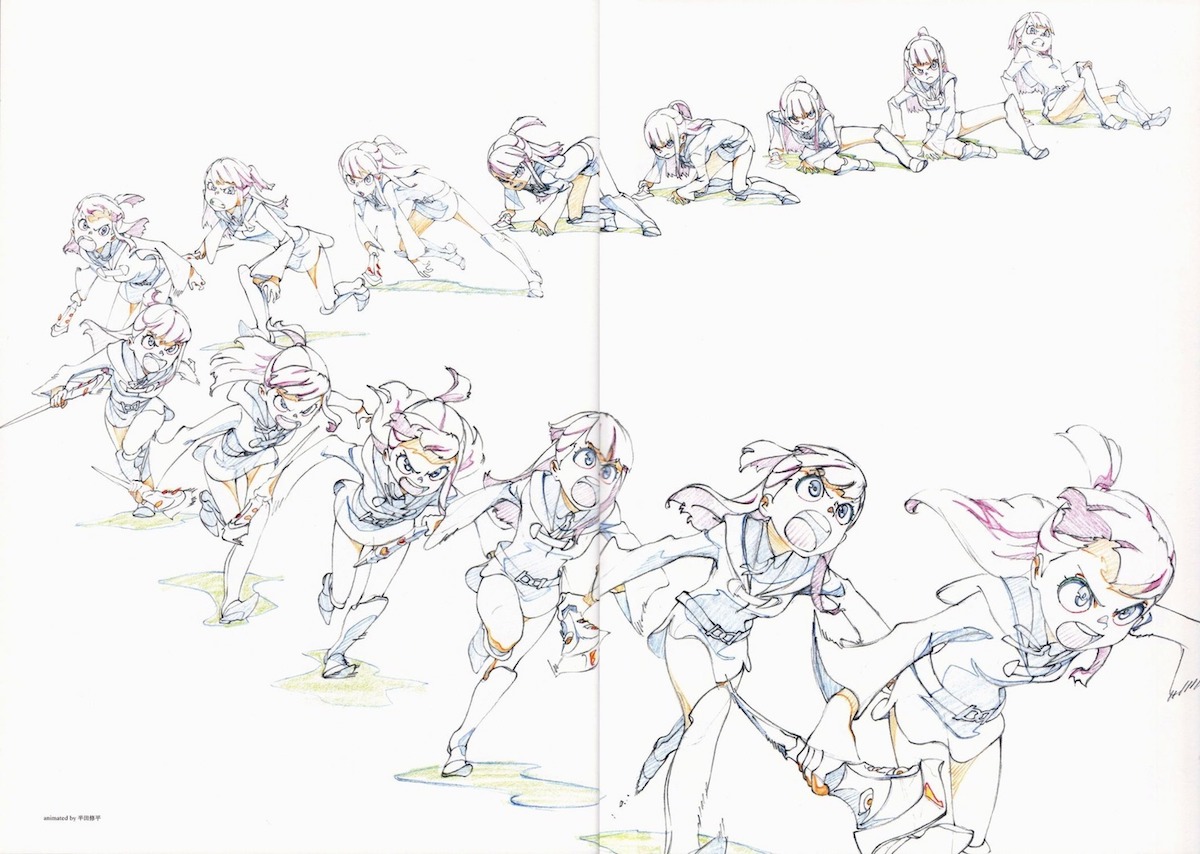
The Twelve Principles of Animation
- Squash and Stretch – Adds elasticity and realism.
- Timing – Controls speed and weight perception.
- Anticipation – Prepares the audience for an action.
- Staging – Clear presentation of ideas and actions.
- Straight Ahead & Pose to Pose – Two approaches to creating movement.
- Exaggeration – Enhances clarity and emotional impact.
- Solid Drawing – Ensures weight, depth, and balance.
- Appeal – Creates charm and engagement.
- Follow Through & Overlapping Action – Realistic continuation of motion.
- Slow In & Slow Out – Natural acceleration and deceleration.
- Arcs – Organic movement paths.
- Secondary Action – Adds depth to primary actions.



PREPARING FOR MY ESSAY AND PRESENTATION:
Question option 4What is the Uncanny Valley, and how does it relate to visual effects?Explain the concept of the Uncanny Valley and use specific movies as examples to show how it appears in films. Discuss where the Uncanny appeared within special effects, computer-generated imagery, or 3D animation. For example, in Spielberg’s The Adventures of Tintin, the characters look too human yet not human enough, creating a strange and unsettling effect. Use examples to support your explanation.
|
The uncanny valley is characterised by the feeling of uneasiness and uncomfortable feeling made by creatures, objects or robots that appear or are designed to look human but in a way fail to do so.
this theory was created by a roboticist named Masashiro Mori in an essay back in 1970.
he proposes that as human likeness increases in an object’s design, so does one’s affinity for the object but only to a certain point.
once it becomes to perfect it begins become bad or give a feeling of repulsion or eeriness.
This phenomena is very important to movies and vfx artists because it may underpin the way in which viewers respond to movies and or how well the movie is received.
This could be the movie being less believable, characters not looking realistic or even the audience not liking the emotional depth shown within characters.
Bibliography sources:
Perera, A. (2023) Uncanny Valley: Examples, Effects, and Theory. Available at: https://www.simplypsychology.org/uncanny-valley.html#Theory (Accessed: 03 December 2025).
Diekhof, E. (2025) The uncanny valley effect and immune activation in virtual reality
Available at: https://www.nature.com/articles/s41598-025-15579-4 (Accessed: 04 December 2025).
Tinwell A. (2014). The uncanny valley in games and. Boca Raton: CRC Press.
Essay:
To begin this essay we will start by exploring the core concepts, notions and feelings that make up what we call the uncanny valley as well as steps that can be taken to avoid it. Following this I believe I will be able to thoroughly surmise not only why it appears in special effects but also be able to give my take on why it at least in my opinion I will never go away so long as humans exist in media. The uncanny valley was a think piece theory that was created by Masashiro Mori in an essay in the 1970s, according to Mori, m (2012) it proposes that as human likeness is increased in a design whether that be a robot, humanoid or other there comes a limit in which people have an affinity to it after this threshold you step into the uncanny valley and we begin to feel emotions such as uneasiness, fear, repulsion and so on. The near perfectness of the object or design at hand is supposedly the trigger for these emotional responses. However based on research this may not be the only cause.
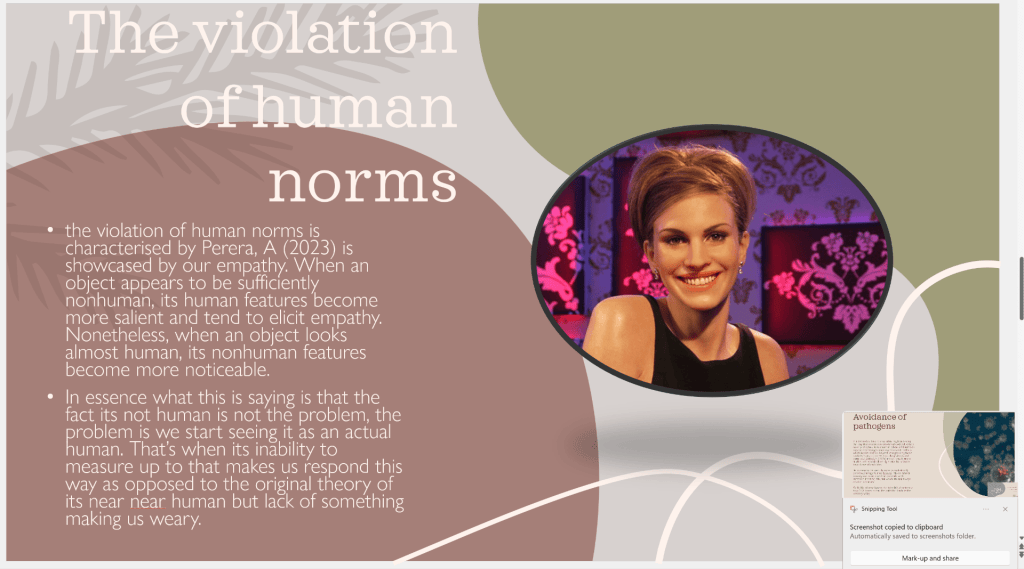
Many ideas and conversations surround the uncanny valley that try to extrapolate on the work of masashiro. As highlighted by Perera, A (2023) the violation of human norms is characterised by “When an object appears to be sufficiently nonhuman, its human features become more salient and tend to elicit empathy. Nonetheless, when an object looks almost human, its nonhuman features become more noticeable. The failure of an object of this ilk to measure up to the normative expectations established for a human generates in the observer a feeling of strangeness.” in essence what this is saying is that the fact its not human is not the problem, the problem is we start seeing it as a actual human its inability to measure up to that is what makes us respond this way as opposed to the original theory of its near perfection but lack of something making us weary. The other idea of the avoidance of pathogens is my favourite by far is it perfectly encapsulates my response to the uncanny. it is defined as the uncanny valley might activating the cognitive mechanism which had evolved to help avoid pathogens. To summarise robots and androids may be resembling human organisms with defects which implies disease. beyond that greater genetic similarity is associated with catching viruses and parasites. Diekhof, E. (2025) shows a multitude of studies and provides keen sight into the scientific breakdown of each idea. In particular it is important to note that they say “In addition, humans are even sensitive to very subtle sickness cues such as pale lips, redder eyes, patchy skin or changes in gait patterns as shown in studies that induced a transient inflammatory state by controlled endotoxin challenge. Since humans cannot directly perceive pathogens, they have to rely on indirect sensory and social cues that correlate with increased infection risk, but which are not always reliable indicators” A simple way to break down this extract is to highlight that there is a biological factor that is active during experiencing the uncanny that triggers humans to steer clear of infection even on a subconscious level. The provided references and studies to the claims which makes the source far more reliable. With this information on the table it is clear to see how VFX tends to trail the path that leads to the uncanny valley. The increased usage of CGI, 3d modelling and 3d character animation it is inevitable that somewhere down the line characters, especially those made to appear photorealistic would become uncanny for people regardless of which avenue you lean into.
The uncanny is not exclusive to movies and robots, its very prevalent horror genre including games. as explored in Tinwell, A., Grimshaw, M. and Williams, A. (2010) when they discuss: Francis in Left 4 Dead (Valve 2008). Silent Hill Homecoming (Konami 2008), Resident Evil 5 (Capcom 2009), BioShock 2 (2K Games 2010) and Calling (Hudson Soft 2010).upon researching into their ideas i came to some conclusions on my own. I looked into Resident evil’s Mia winters who is designed to look very realistic however some of her assets/features are either poorly render or just don’t look quite right giving you a particularly eerie feeling. She gives of a look that makes you think she’s sick or contaminated. which may or may not be done intentionally given the themes in resident evil. Whether accidental or not is not relevant however as it could be chalked up to purposely using the uncanny valley or stumbling upon it accidentally. in any case it proves the existence of it and that Resident evils roster of characters are no exception to valley to obvious varying extents. As CGI and 3d modelling tries to become more photorealistic and strives to blur the line between real life and fiction so too does the valley appear in front of people because it is this strive for perfection in human likeness that fails to be that causes the valley to exist, a self fulfilling prophecy in layman’s terms. Notably this opinion seems to shared by a few others who have written on the topic. In her own book Tinwell (2014 pp-178) verbatim states “However, I propose that neither technology nor neurological adaptation will offer a lifeline out of the Uncanny Valley. Instead, I propose that we may become less tolerant and ever more discerning of abnormalities in a human- like character’s appearance” Such a statement would coincide with the belief of the futility to fight the uncanny as it may just be a function ingrained into the human mind with evolution being the farmer that planted it there. To be clear, While I do believe that the avoidance of pathogens idea provides a more clear depiction, that in no way does this idea or alternative explanation downplay or disprove any others related to the uncanny valley.
To conclude the uncanny valley is best described as a repulsions or aversion to human-esque features, models or objects that are on the brink of perfection but not quite there yet. Based on my research it is clear to me that the particulars of how one ends in up in the uncanny are ever changing and not stagnant. vfx, CGI and 3d modelling are in some regard going to be linked to the uncanny as the mere attempt to depict human likeness regardless of the specific idea or reasoning behind it will invoke it in some highlighting its on going relevancy.
Bibliography sources:
Perera, A. (2023) Uncanny Valley: Examples, Effects, and Theory. Available at: https://www.simplypsychology.org/uncanny-valley.html#Theory (Accessed: 03 December 2025).
Diekhof, E. (2025) The uncanny valley effect and immune activation in virtual reality
Available at: https://www.nature.com/articles/s41598-025-15579-4 (Accessed: 04 December 2025).
Tinwell A. (2014). The uncanny valley in games and. Boca Raton: CRC Press.